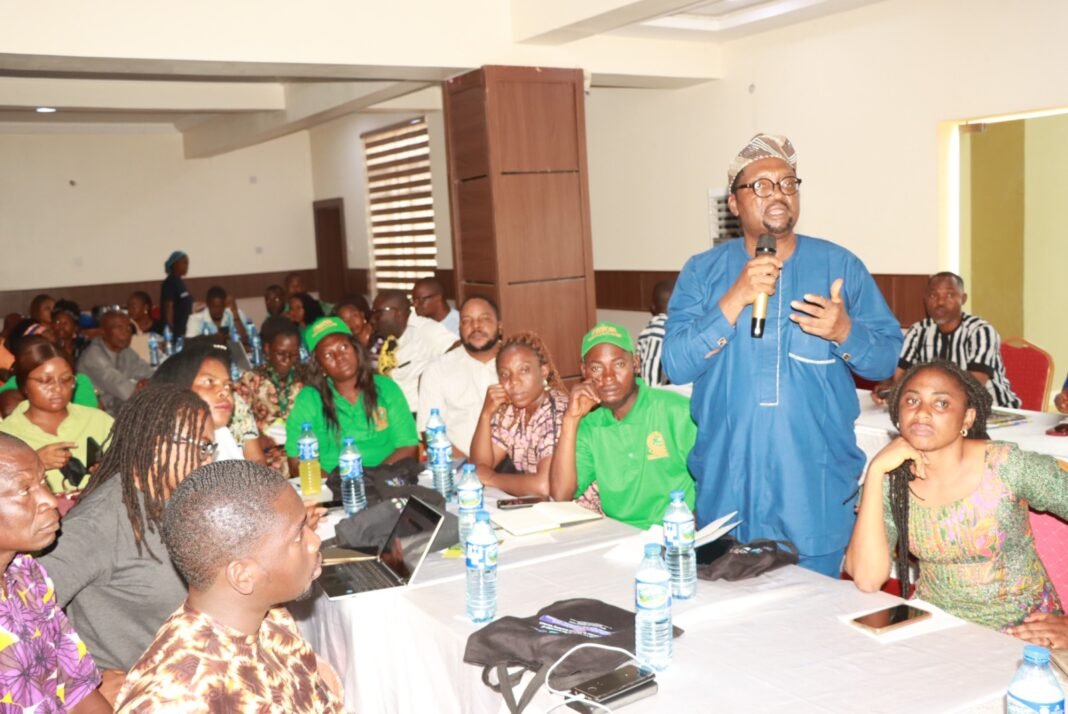

The General Secretary of the Federation of Informal Workers’ Organisations of Nigeria (FIWON), Comrade Gbenga Komolafe, was in Makurdi for a two-day State-Level Social Dialogue on Extending Social Protection to Workers in the Informal Economy, held at Doo Palace Hotel. His presence at the dialogue, organised under the European Union-funded SUSI project and facilitated by the International Labour Organisation (ILO), signalled FIWON’s readiness to champion the rights of informal workers in Benue State.

Comrade Komolafe has spent nearly two decades organising informal economy workers across Nigeria, building FIWON from its inauguration in Abuja in 2010 into a national force that now represents over 700 community-based associations across more than 20 states and 28 sectors. Under his leadership, the federation has consistently pressed the Federal Government on the issues that matter most to traders, artisans, farmers, transport workers, domestic workers, and the self-employed: access to health insurance, pension coverage, workplace injury compensation, and an end to the harassment and extortion that plague informal workers daily.
The Benue dialogue brought those demands directly to the state level. Over two days, Comrade Komolafe and FIWON members sat alongside officials from the Benue State Government, the Federal Ministry of Labour and Employment, the Federal Ministry of Humanitarian Affairs and Poverty Reduction, and the Benue State Budget and Economic Planning Commission to draft a State roadmap for extending social protection to informal economy workers. The dialogue drew on the outcomes of the December 2025 National Dialogue in Abuja, where the Federal Government pledged to bring social protection to over 60 million Nigerians in the informal sector, and was grounded in ILO Recommendation No. 202 on social protection floors and ILO Recommendation No. 204 on the transition from the informal to the formal economy.
For Benue State, where farming, petty trading, and artisan work sustain the majority of the working population, the stakes are high. Informal workers across the state lack pensions, have no health insurance tied to their work, and receive no compensation when injury or illness strikes. FIWON’s position, which Comrade Komolafe has articulated repeatedly at the national level, is unambiguous: social protection is a right, not a privilege, and the government must move beyond tokenism to deliver real, funded, and accessible safety nets.
The dialogue concluded with the validation of key messages, a State communique, and agreed next steps, including the establishment of a focal working group to drive the roadmap forward. Comrade Komolafe’s participation in the closing remarks underscored the point that FIWON is not simply observing the process in Benue State. The federation, under his leadership, intends to hold government and partners accountable until the traders in Makurdi’s markets, the farmers in the state’s rural communities, and the artisans in its workshops have the protection they have been denied for too long.