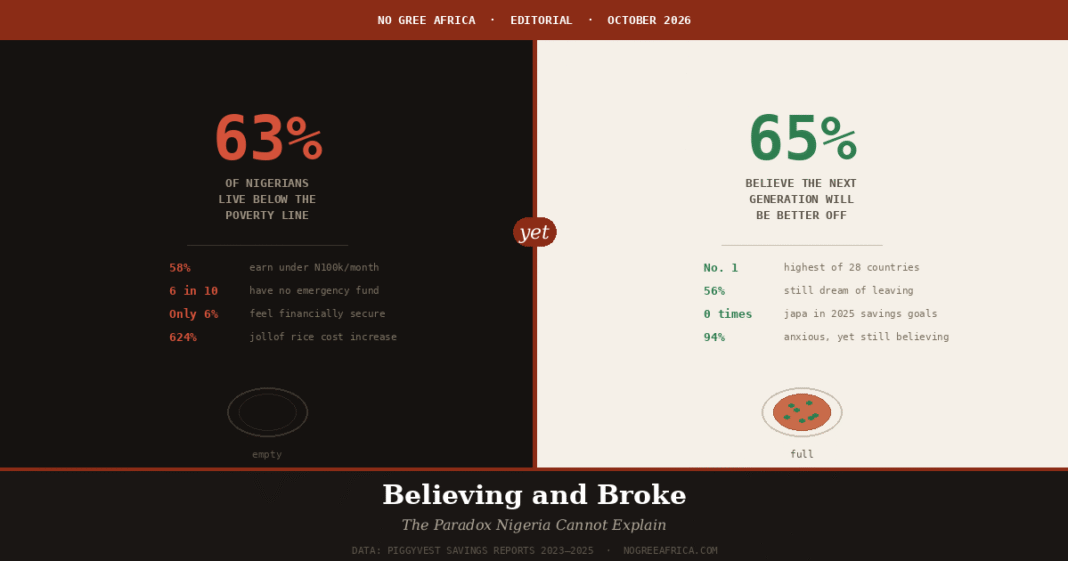

The numbers say Nigeria is falling apart. The people living inside those numbers say something stranger: they still believe. An editorial drawn from three years of data on how Nigerians earn, save, spend, and imagine their future.
NoGreeAfrica Editorial Board · Abuja, FCT · October 2026
There is a version of Nigeria that exists only in data. It has been surveyed, tabulated, and cross-referenced across nearly 30,000 respondents over three years. The PiggyVest Savings Reports, conducted annually from 2023 to 2025, constitute one of the most granular pictures of Nigerian household economics produced outside of government. The findings were presented by PiggyVest co-founder Odunayo Eweniyi at the company’s OpenHouse event in Lagos on September 28, 2026. What they describe is a country in severe and worsening distress.
Start with income. Fifty eight percent of Nigerian adults earn under N100,000 a month, or nothing at all. That figure alone would be alarming. But the generational breakdown turns alarm into something closer to structural emergency.
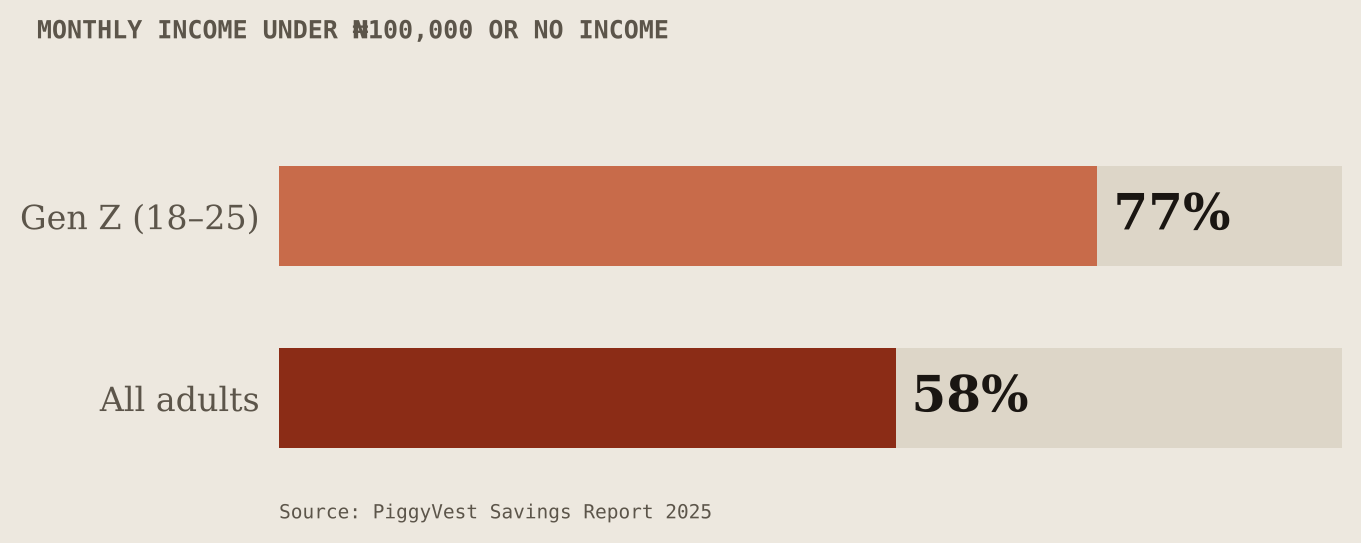
Seventy seven percent of Gen Z earners fall below that threshold. These are not adolescents. These are adults between 18 and 25 who are already in the workforce, already making daily economic decisions, and already discovering that those decisions lead almost nowhere. A country where more than three quarters of its youngest workers cannot earn a living wage is not simply experiencing a downturn. It is watching its own future labour force form under conditions that make upward mobility nearly impossible.
— The savings collapse —
Income alone does not tell the full story. What people do with their income, or fail to do, reveals the depth of the pressure. In 2023, roughly one in five Nigerians reported that they did not save at all. By 2025, that number had crossed the halfway mark. More than half of all respondents did not save a single naira over the course of the year.
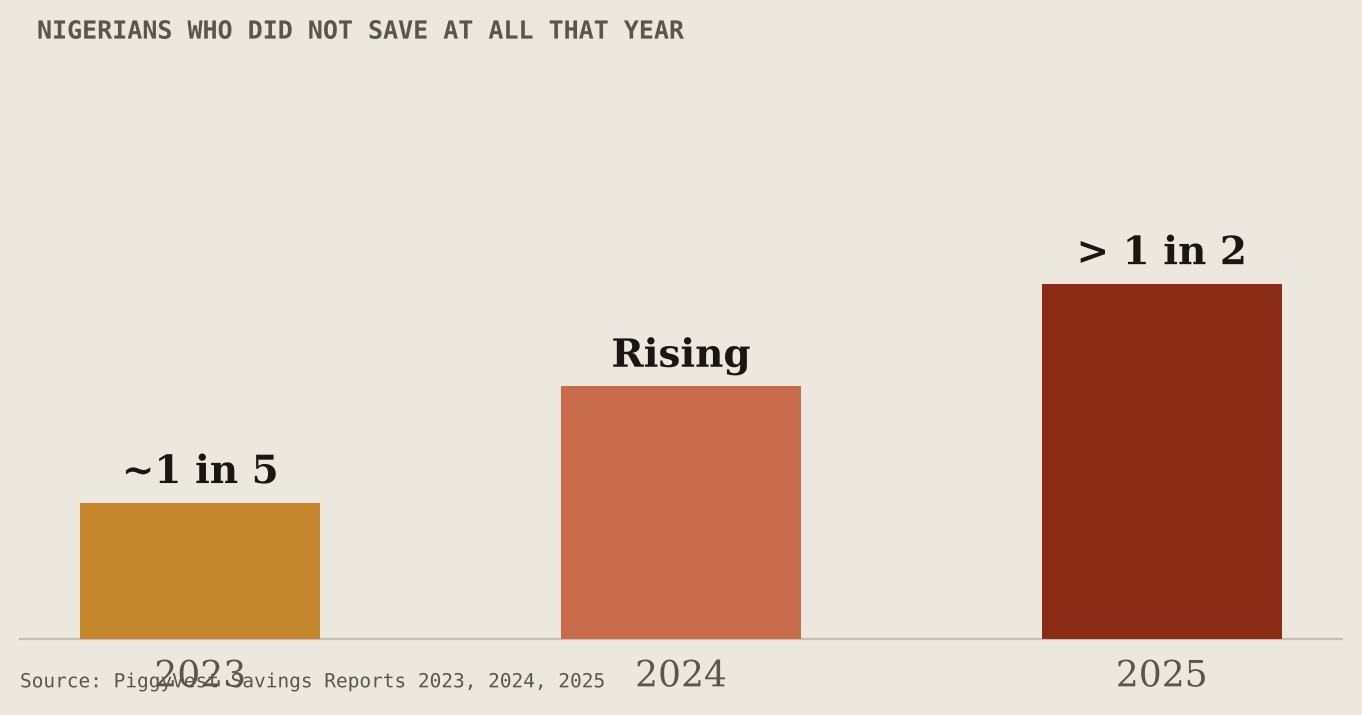
The velocity of that change matters as much as the number itself. To move from 20 percent to over 50 percent in two years is not a gradual deterioration. It is a collapse. It means that millions of Nigerians who were saving in 2023, however modestly, have since lost the ability to set anything aside. They did not choose to stop. The arithmetic stopped permitting it.
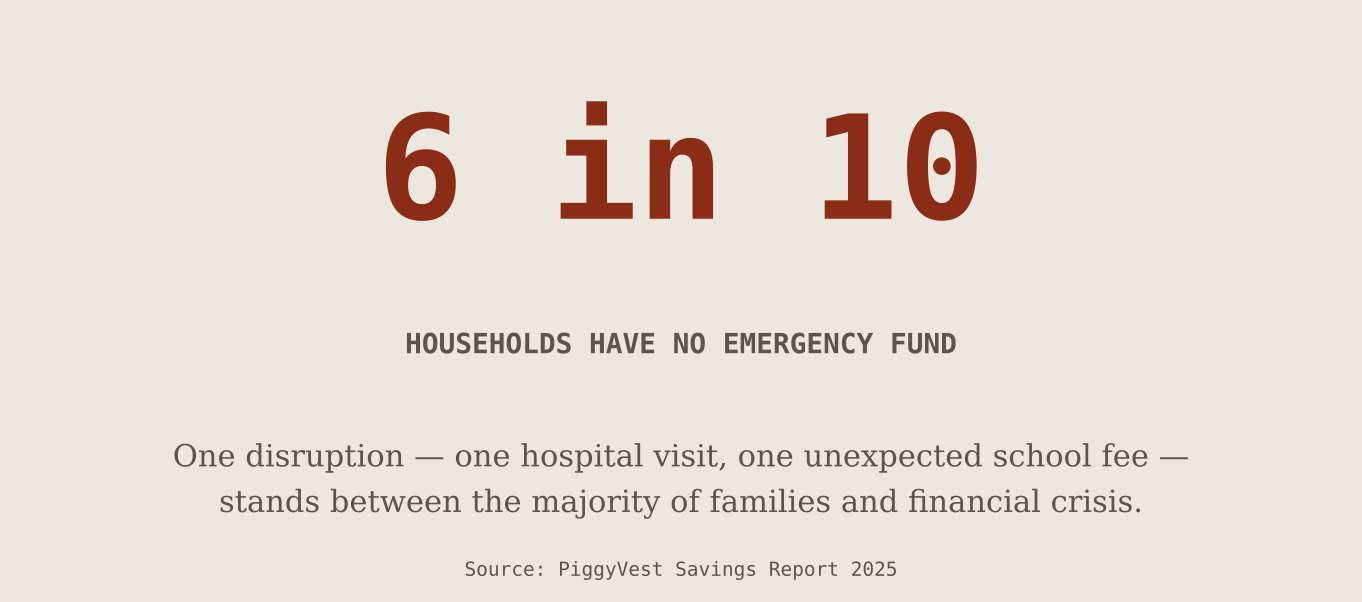
Six in ten households have no emergency fund. In practical terms, this means a single disruption, one hospital visit, one car repair, one school fee deadline, separates the majority of Nigerian families from financial crisis. There is no cushion. There is only the next expense and whatever remains of the current month’s income.
— The cost of eating —
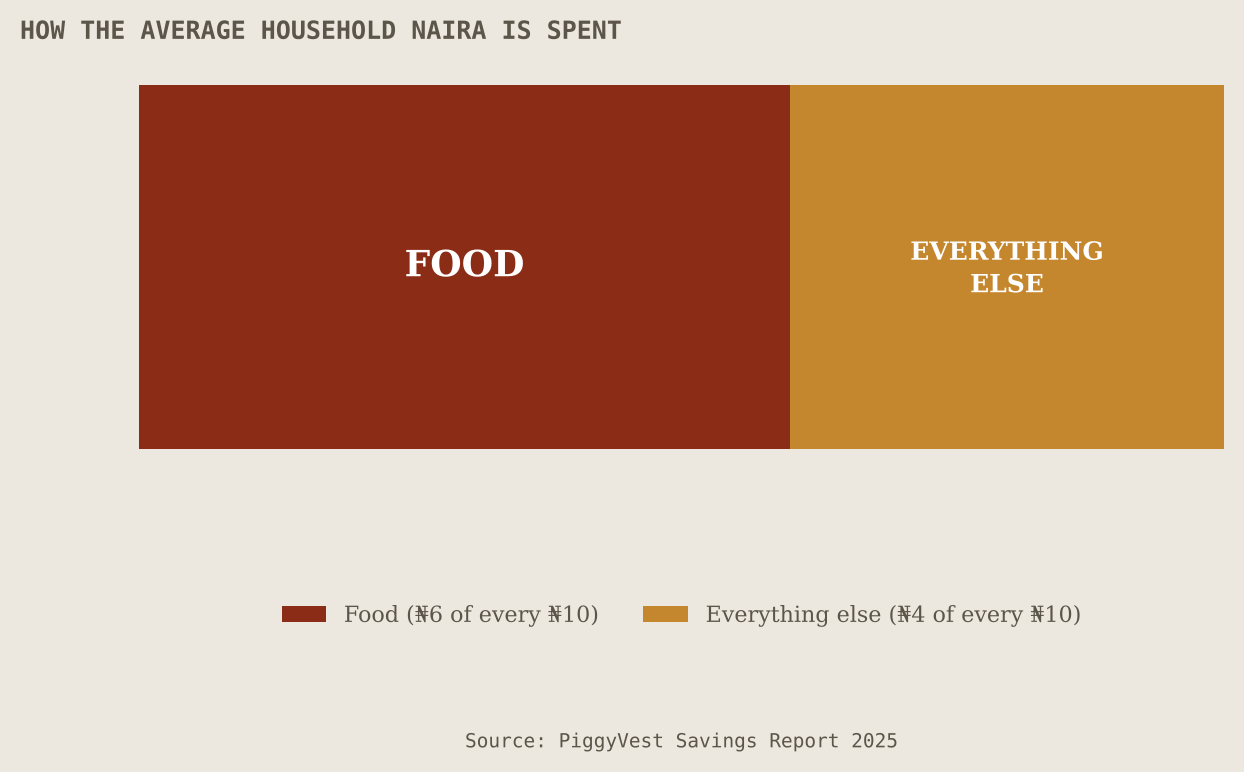
Where the money goes reveals why none of it remains. Six of every ten naira earned by the average Nigerian household is spent on food. Not on housing, not on education, not on transport. On food. That ratio has compressed everything else in the household budget into an increasingly narrow margin, and even that food spending is not producing adequate nutrition. It is producing survival.
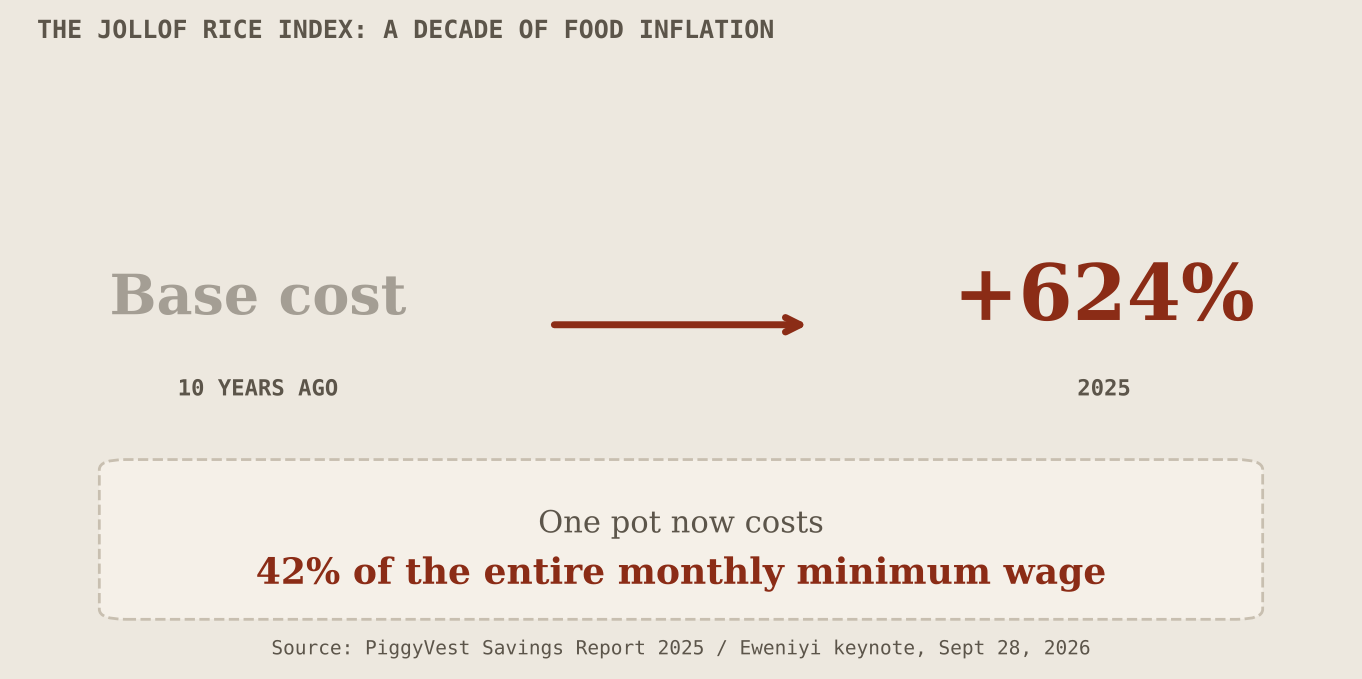
The jollof rice index, imprecise as it is, captures the trajectory better than any macroeconomic indicator. The cost of preparing one pot of jollof rice has increased by 624 percent over the past decade. That same pot now consumes 42 percent of the monthly minimum wage. A single meal, prepared once, for one household, taking nearly half of the minimum income a Nigerian worker is legally guaranteed.
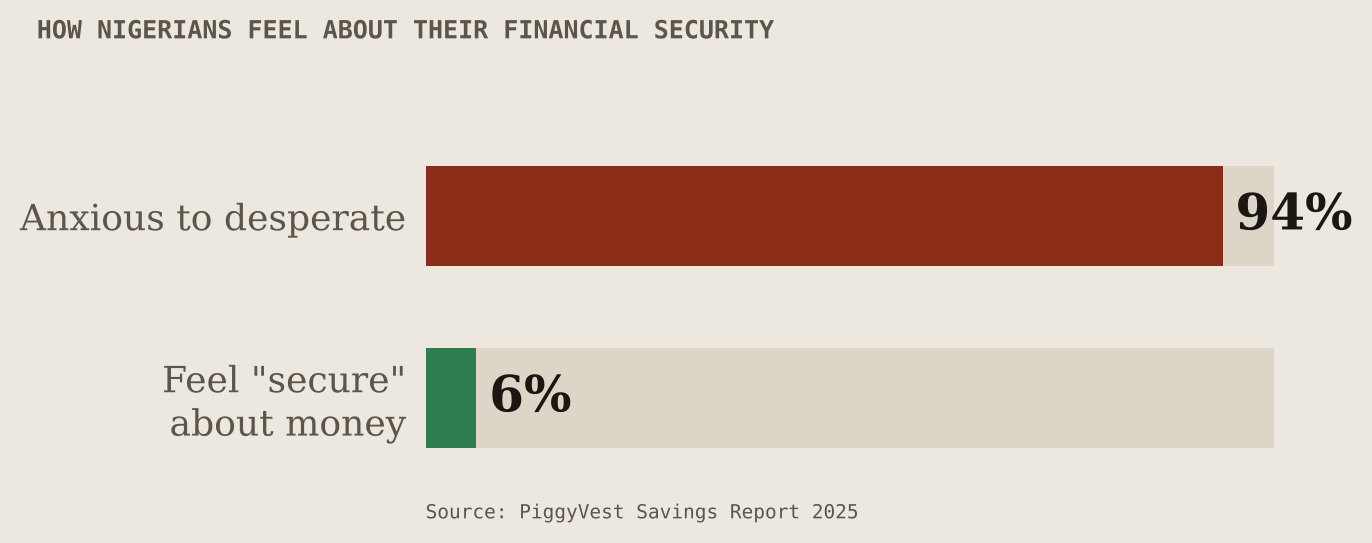
These are not isolated data points. They are the coordinates of a single picture, and the picture they compose is of a country where the majority of the population is spending most of what it earns on food, saving nothing, and holding no reserve against the next shock. Sixty three percent of Nigerians live below the national poverty line. That translates to approximately 140 million people. Only six percent of all respondents in the PiggyVest survey said they felt “secure” about their financial situation. The remaining 94 percent occupy a spectrum that runs from anxious to desperate, and most of them are closer to the desperate end.
— The other country —
That is one Nigeria. The other one lives in the same households, earns the same salaries, eats from the same shrinking plates, and reports something that the data cannot easily explain.
Sixty five percent of Nigerians surveyed said they believe the next generation will be better off than this one. That figure is the highest recorded in any of the 28 countries where similar polling has been conducted. In a nation where more than half the people cannot save and more than half the young cannot earn a living wage, nearly two thirds still look at their children and see a future that improves.
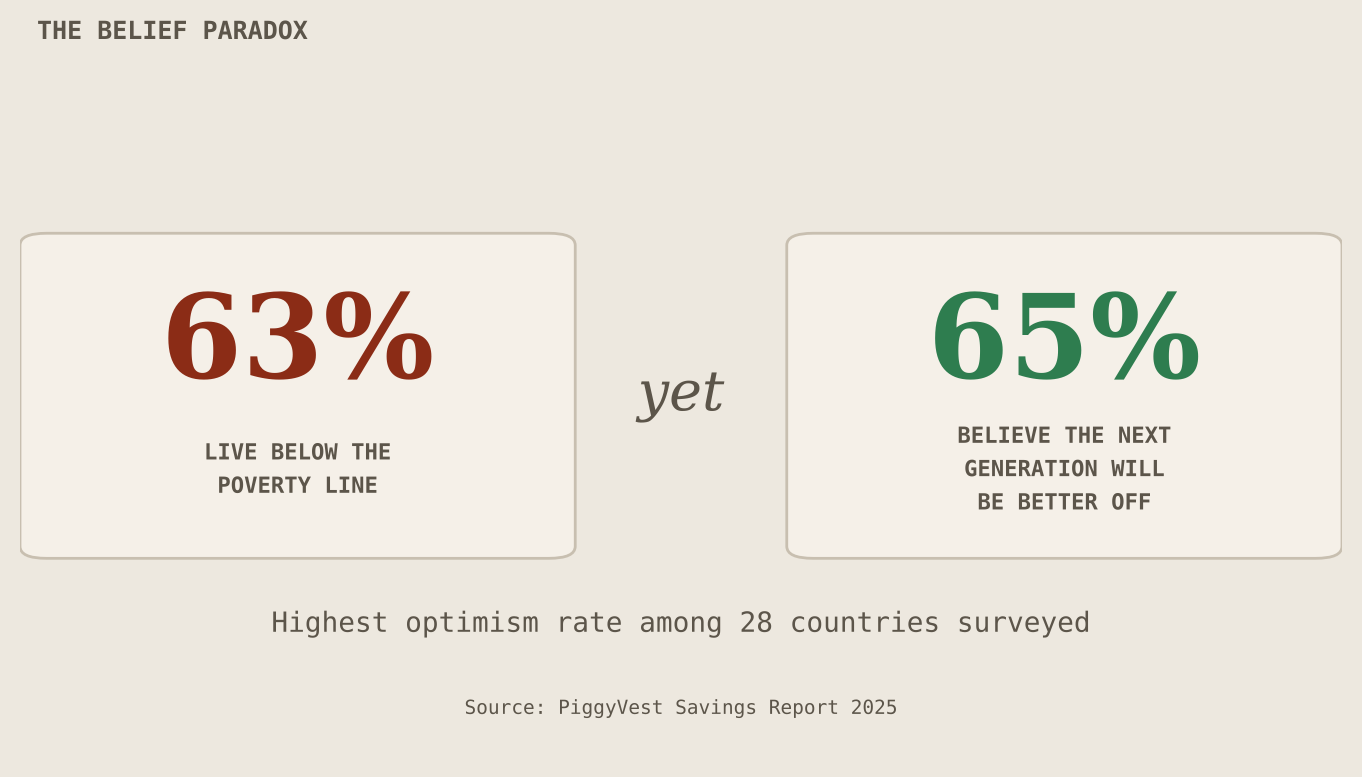
The contradiction is not small. It is the central fact of Nigerian economic life in 2026, and it deserves to be examined rather than celebrated or dismissed.
Optimism in the face of deprivation is not necessarily irrational. It can reflect genuine resilience, a cultural refusal to surrender, a spiritual orientation that finds meaning beyond material conditions, or the deep parental instinct to believe that one’s suffering is purchasing something for the next generation. But it can also reflect something less comfortable: the absence of alternatives. When a person cannot leave, cannot save, and cannot change their material circumstances through any action available to them, belief in a better future is sometimes the only resource that remains. It is not always hope. Sometimes it is the last thing standing between a person and the conclusion that nothing will change.
— The exit that closed —
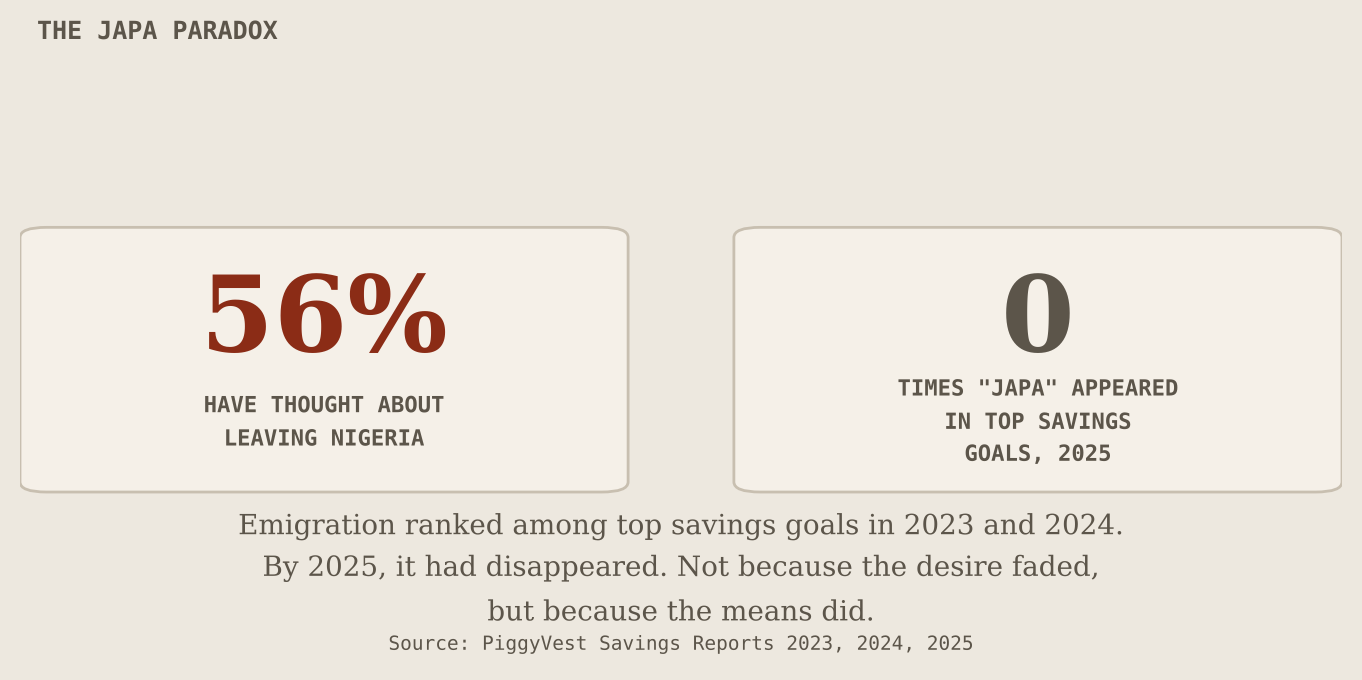
The PiggyVest data offers one piece of evidence for this reading. In 2023 and 2024, “japa,” the colloquial term for emigration, ranked among the top savings goals Nigerians reported. In 2025, it dropped off the list entirely.
That shift did not occur because fewer people want to leave. Fifty six percent still say they have thought about it. It occurred because fewer people can afford to plan for it. The aspiration did not fade. The means did. What remains is the belief, stripped of the exit strategy that once accompanied it.
— The fracture —
This is the fracture that the editorial boards and policy roundtables have not adequately named. Nigeria is not simply a country where people are struggling. It is a country where the distance between what people experience and what they expect has become so wide that the two no longer influence each other in predictable ways. A government reading the optimism numbers could conclude that the public is coping. A government reading the savings numbers would conclude that the public is collapsing. Both readings would be correct. Neither would be complete.
The question is not whether Nigerians are resilient. The evidence for that has never been in dispute. The question is what that resilience is costing them, and whether a country should require it in this quantity.
No Gree Africa Editorial Board
No Gree Africa’s position is that this gap itself is the story. Not the poverty alone. Not the optimism alone. The fact that they coexist without resolving into either despair or collective action is what makes this moment different from previous economic crises. The people are not rioting. They are not saving. They are not leaving. They are believing, and they are broke, and those two facts sit side by side in the same households across Lagos, Abuja, Kano, and Port Harcourt without producing the friction that historically forces change.
That is the tale of two countries. Not the rich and the poor, though that division is real and worsening. The deeper split is between the Nigeria the numbers describe and the Nigeria its people insist on imagining. The question this editorial puts forward is whether that imagination is a national strength or a national anaesthetic. Whether belief, untethered from material improvement, eventually becomes the thing that sustains a country or the thing that allows its conditions to persist unchallenged.
The answer will not come from another survey. It will come from what happens next.
No Gree Africa is an independent investigative journalism publication based in Abuja, Nigeria. Visit nogreeafrica.com
Data cited in this editorial is drawn from the PiggyVest Savings Reports (2023, 2024, 2025), surveying nearly 30,000 Nigerians, as presented by Odunayo Eweniyi at the PiggyVest OpenHouse, Lagos, September 28, 2026.