

NoGree Africa Editorial Desk
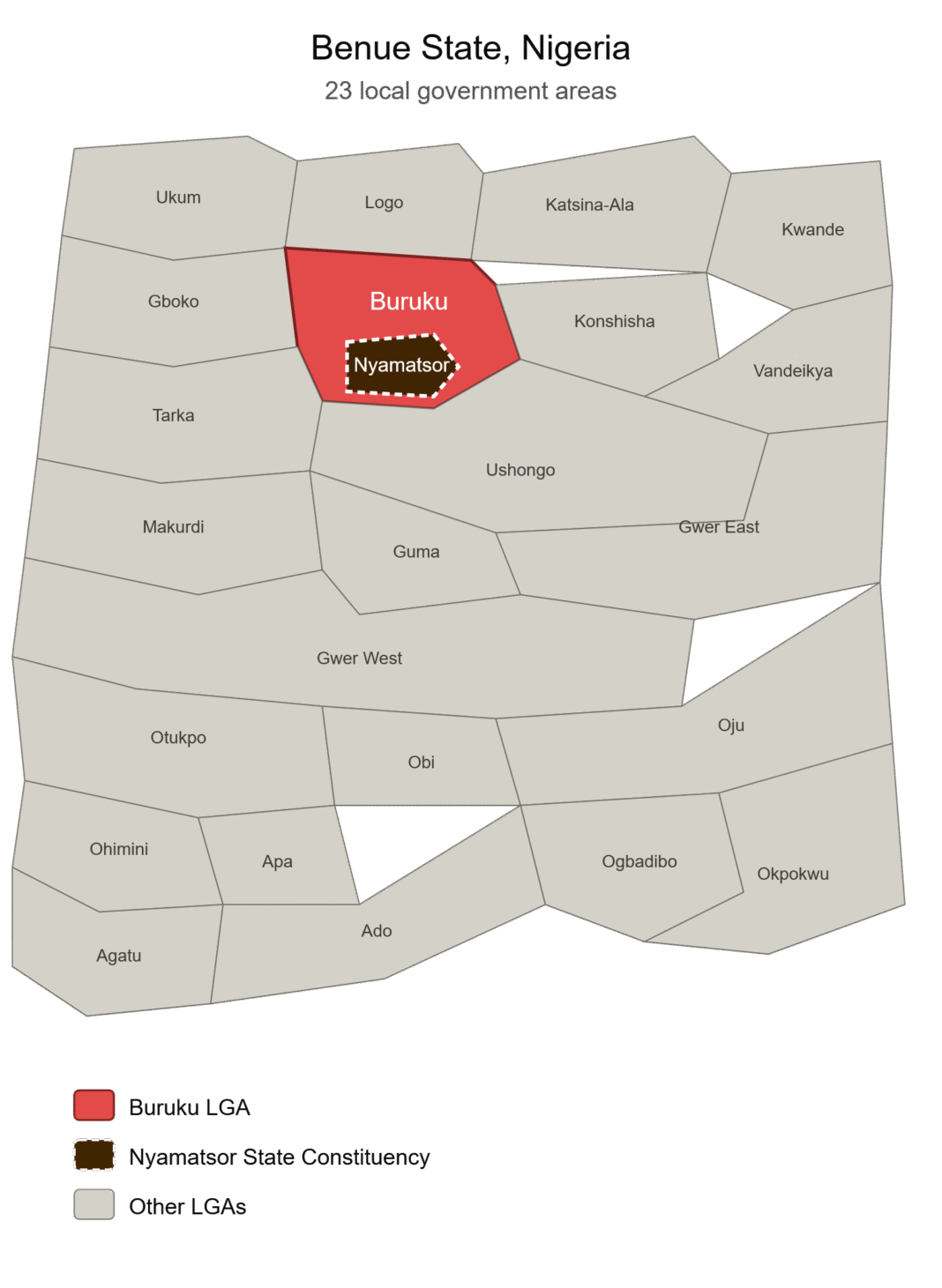
Nyamatsor State Constituency does not appear in most accounts of Nigerian electoral history. For 26 years, it was absent from the ballot. It did not send a representative to the Benue State House of Assembly. As a result, it received no legislative resources or constituency projects.
For all practical purposes, it did not exist.
However, it did exist. The story of how it was removed, why it stayed removed, and what finally brought it back reaches far beyond one constituency in Buruku Local Government Area of Benue State. It is a story about 66 constituencies across 19 Nigerian states. INEC suppressed all of them in a single administrative exercise and left them unrepresented for more than two decades.
A constituency born in the Second Republic
Nyamatsor State Constituency came into existence under the Constitution of the Federal Republic of Nigeria, 1979. It comprised eight council wards within Buruku Local Government Area: Mbakyaan, Mbayaka, Mbaakura, Mbatyough, Mbaade, Mbazagee, Etulo, and Shorov.
From 1979 onward, the constituency elected members into the Benue State House of Assembly. It continued to do so until the military aborted the Third Republic in 1993.
When civilian governance returned in 1999, Nyamatsor did not return with it.
The 1998 suppression
During the transition from military to civilian rule, INEC carried out a delineation of state constituencies ahead of the 1999 general elections. In that exercise, the Commission excluded Nyamatsor from the electoral map. It also excluded 65 other state constituencies across 19 states.
INEC did not create new constituencies to replace them. It simply removed them.
The constitutional breach
The implications were significant. Section 91 of the 1999 Constitution states that a State House of Assembly shall consist of three or four times the number of seats that state holds in the House of Representatives.
Benue State has eleven seats in the House of Representatives. Therefore, its State House of Assembly should have no fewer than 33 members. After INEC suppressed Nyamatsor, Benue was left with only 32.
The impact on Buruku was even more stark. A single federal constituency should produce at least three state assembly seats under the Constitution. After 1998, Buruku Federal Constituency produced only one.
In addition, INEC folded the eight wards that made up Nyamatsor into the existing Buruku State Constituency. This diluted the representation of communities that had previously had their own voice in the state legislature.
26 years of silence
INEC itself acknowledged the problem. In 2004, the Commission wrote to the National Assembly requesting approval to restore suppressed constituencies across the country. No action followed.
Furthermore, Section 114(1) of the 1999 Constitution requires INEC to review the division of every state into constituencies at intervals of not less than ten years. From 1998 onward, no such review took place for the affected constituencies.
As a consequence, the suppression that was supposed to be a transitional arrangement became permanent by default.
What the suppression meant on the ground
During those 26 years, the people of Mbakyaan, Mbayaka, Mbaakura, Mbatyough, Mbaade, Mbazagee, Etulo, and Shorov continued to vote in state assembly elections. However, they voted as part of a combined Buruku constituency.
Their specific concerns received less attention. Their developmental challenges had less visibility. Their distinct community identities were subsumed into a larger unit where they had less leverage.
The parliamentary push
The campaign to restore Nyamatsor reached the floor of the House of Representatives on 5 March 2025. Hon. Sekav Dzua Iyortyom, the member representing Buruku Federal Constituency, moved a motion titled “Need to Restore Nyamatsor Constituency of Benue State.”
The motion laid out the constitutional case in detail. It noted that Nyamatsor had existed under the 1979 Constitution. It stated that INEC had acted beyond its powers by excluding the constituency during the 1999 transition.
Moreover, the motion pointed out that the continued suppression violated Sections 91 and 112 of the 1999 Constitution. It also noted that the last constituency review by INEC had taken place in 1998. That gap of 27 years far exceeded the constitutional ten year review cycle.
The House resolved to urge INEC to restore the constituency. It also mandated its Committees on Electoral Matters and Legislative Compliance to ensure implementation.
Restoration
On 10 June 2026, INEC announced the restoration of 22 state constituencies across four states. Nyamatsor was among five restored in Benue State. The other four were Ukum Afia, Konshisha III (Shangev-Tiev), Makurdi III (South East), and Gboko III.
The Commission cited court judgments directing the restoration. It also cited the powers conferred on it by the 1999 Constitution and the Electoral Act of 2026.
To facilitate the participation of the restored constituencies in the 2027 general election, INEC fixed 16 to 25 June 2026 as the window for political parties to conduct primaries for candidate nomination.
For the first time in 28 years, Nyamatsor would appear on the ballot.
What comes next
The 2027 election will be the first in which Nyamatsor State Constituency elects its own representative since the return to civilian rule. The winner will not simply fill a seat. That person will build a constituency’s legislative identity from the ground up.
This means establishing relationships with state ministries, fighting for budget allocations, and representing communities that have gone a generation without direct representation.
The challenges are not abstract. These are communities in a riverine local government area where agriculture is the dominant livelihood. The Katsina Ala River basin defines the economic geography of the area. Decades of underrepresentation have left infrastructure and service delivery gaps that a single state assembly member will be expected to address.
NoGree Africa will continue to cover the Nyamatsor story as it unfolds. This is the first in a series that will profile the constituency’s eight wards, examine the candidates and their platforms, and provide civic education for voters participating in a state assembly election for the first time in their constituency’s restored history.