

The official story is simple, and that is precisely the problem.
In the government’s telling, one man — Adeniyi Adeyemi Matthew, a self-described investment promoter and All Progressives Congress member from Oyo State — forged a presidential appointment letter, invented a government agency called the Presidential Foreign Intervention Promotion Council (PFIPC), rented himself an office inside the Federal Secretariat in Abuja, and spent the better part of a year deceiving ministers, regulators, foreign ambassadors and the anti-graft police into believing he ran a real arm of the state. A con artist with a laser printer, now facing eight criminal counts, due in court on July 27.
But a con artist does not appear on pages 50 and 51 of a national budget. And that is where this story stops being simple.
A name that was never invented
Almost everyone has focused on Adeyemi the man. Far fewer have asked where the name came from. Because “Presidential Economic Advisory Council” — the title that sits beside PFIPC in the disputed budget line — was not conjured out of nothing.
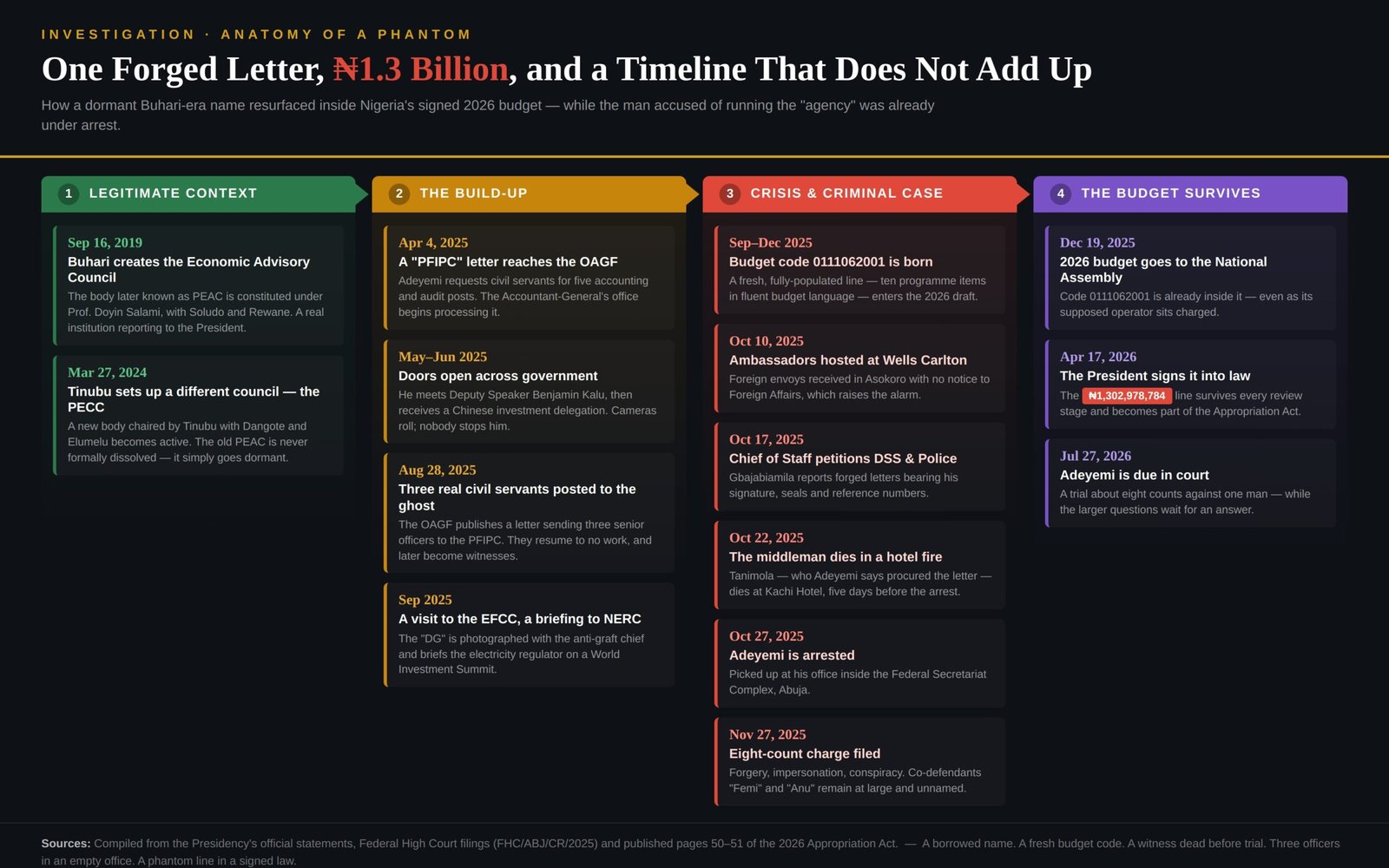
It belonged to a real body. In September 2019, President Muhammadu Buhari constituted an Economic Advisory Council, chaired by the respected economist Professor Doyin Salami, with figures like Charles Soludo and Bismarck Rewane among its members. It reported directly to the President. It had a mandate, a membership and a place in the machinery of government.
When President Bola Tinubu arrived, he built his own economic structure — the Presidential Economic Coordination Council, established in March 2024, chaired by Tinubu himself alongside Aliko Dangote and Tony Elumelu. A different name. A different structure. A different purpose.
Crucially, the older Buhari-era council was never formally dissolved. No gazette retired it. No Budget Office circular revoked its identity. It simply went quiet. And in Nigeria’s administrative system, dormant is not the same as deleted.
That dormancy is the hinge on which this entire affair turns. Whoever placed the disputed line in the 2026 budget did not need to invent something a reviewer might flag. They reached for a name that already carried institutional weight — familiar enough to survive a glance, obscure enough that few would remember it had gone dark under a previous administration. That is not the instinct of a random fraudster. It is the instinct of someone who understands how presidential advisory bodies are named, coded and tracked inside the budget system — knowledge that does not circulate on the street.
What the budget documents actually show
A line-by-line reading of Nigeria’s recent appropriation records is revealing. The Presidential Economic Advisory Council does not appear in the 2024 Appropriation Act. It does not appear in the 2025 Act. Budget code 0111062001 exists in neither.
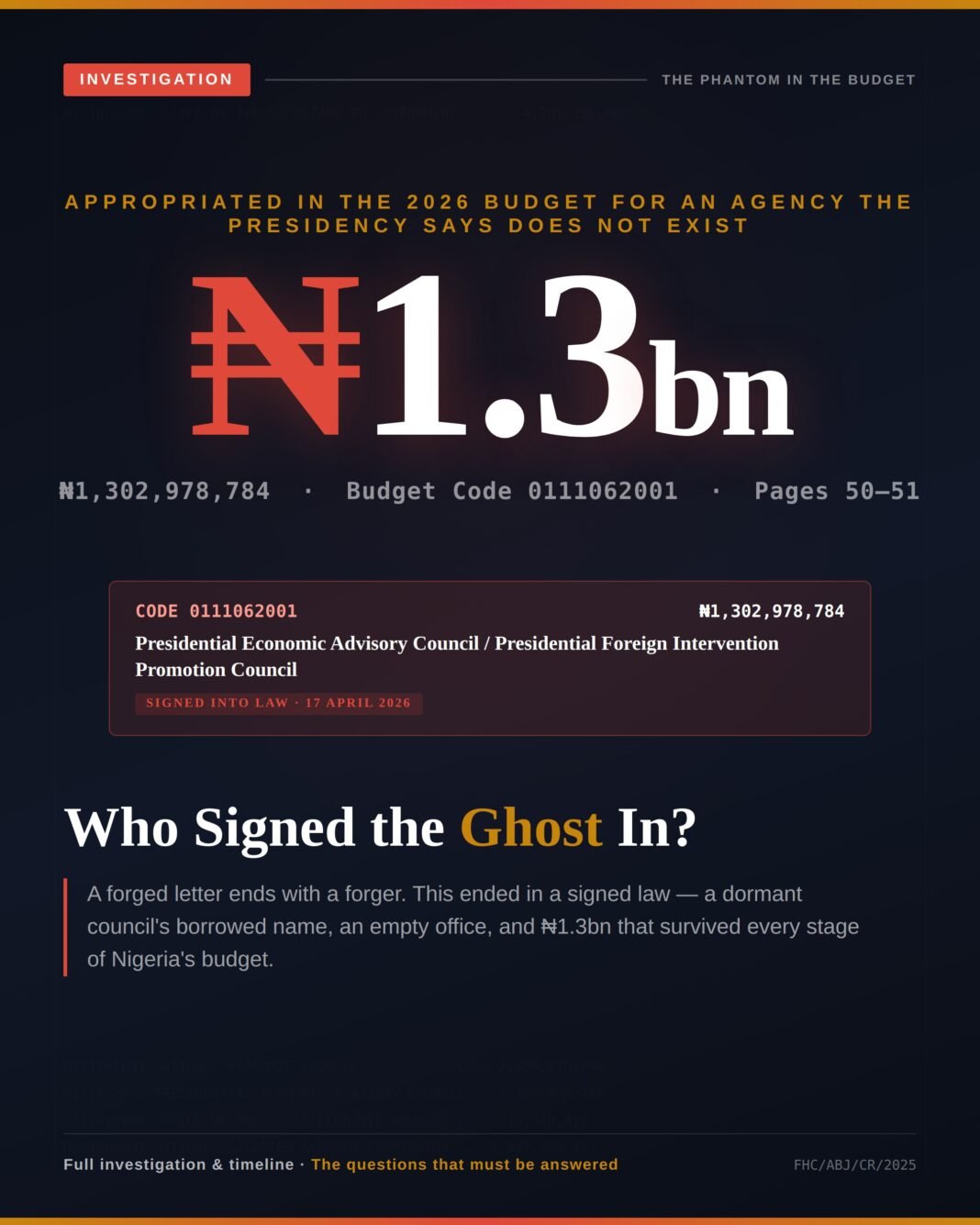
It surfaces for the first time in the 2026 Appropriation Act, signed into law on April 17, 2026, listed as “Presidential Economic Advisory Council / Presidential Foreign Intervention Promotion Council,” with a total allocation of ₦1,302,978,784.
This is no vague placeholder. The breakdown runs to roughly ₦803 million in personnel costs, ₦200 million in overhead and ₦300 million in capital — the capital tranche itself split into ten specific programme lines, including logistics for a “World Investment Summit 2026,” a Harvard negotiation programme, a WTO trade course and assorted management training. Someone fluent in the exact grammar of Nigerian budget submissions sat down and populated that line with care.
And the timing is the part that should keep auditors awake. That code was drafted and inserted during the September-to-December 2025 budget preparation window — the very months in which Adeyemi was arrested (October) and criminally charged (November). The alleged mastermind was in handcuffs while his “agency” was being quietly written into the nation’s finances.
Three officers, one empty room
If the paperwork is damning, the human detail is stranger still.
On the strength of a letter dated April 4, 2025, written on PFIPC letterhead, the Office of the Accountant-General of the Federation processed a request to staff five accounting and audit positions. On August 28, 2025, three senior civil servants — an assistant chief accountant and two audit officers — were formally posted to the council. Their posting letter was published on the OAGF’s own website.
They reported for duty. And then, according to their statements to police investigators, nothing happened. No schedules. No files. No mandate. No briefings. One described going to the office roughly once a week because there was simply nothing to do. All three said they had never heard of the agency until they saw their own names on the posting letter.
The uncomfortable question writes itself: before dispatching three officers of the federal service and publishing their deployment, did anyone at the OAGF pick up a telephone and ask the Secretary to the Government of the Federation whether this council actually existed? On the available record, the answer appears to be no.
A witness who will not testify
Then there is the fire.
In his statement to police, Adeyemi named one Dolapo Babatunde Tanimola as the man who helped him procure the appointment letter — a potential witness at the very heart of the forgery allegation. According to the Presidency’s own account, when investigators went looking for Tanimola, they found he had died in a fire at Kachi Hotel in Utako, Abuja, on October 22, 2025 — five days before Adeyemi’s arrest. Police say they viewed the body at the morgue.
Whatever the truth of it, the effect is stark: the one person who could corroborate or demolish Adeyemi’s central claim about how the letter was obtained is beyond the reach of any court.
The government’s contradiction
The Presidency, through spokesman Bayo Onanuga, has been firm: the agency never existed, no government money entered the accounts, and Adeyemi is a serial fabricator who opened dozens of bank accounts — 34 in total, nine in the names of fictitious bodies — and misled the OAGF into helping him open a Central Bank account.
Adeyemi tells a different story. He insists he holds a genuine appointment letter and alleges that the Chief of Staff, Femi Gbajabiamila, received ₦400 million through a proxy, demanded a further ₦200 million, and sought 48 per cent of a purported take-off grant. Gbajabiamila denies all of it and was, in fact, the first official to disown him.
One does not have to believe a word Adeyemi says to notice the hole at the centre of the official version. As former Vice President Atiku Abubakar put it, the explanation asks Nigerians to accept that a lone private citizen forged presidential documents, embedded an office in the Federal Secretariat, opened treasury-linked accounts at the CBN, hosted foreign envoys — and inserted a phantom agency into the national budget — entirely without insider help. That, he argued, demands more faith than the scandal itself.
Because whatever Adeyemi did or did not forge, he did not personally sit on the budget defence panels. He did not chair the National Assembly committees. He did not sign the Appropriation Act. Those are functions of the state. And the state’s own signature is on the document.
THE AUDITOR’S QUESTIONS: What This Case Must Answer
Framed as a financial-crime and intelligence audit would frame them — specific, assignable, and demanding a name attached to each answer, not a press release.
On the money trail (follow the code, not the man):
- Who physically submitted budget code 0111062001 into the 2026 estimates, through which MDA desk, and under whose electronic login on the GIFMIS/Budget Office system? Every entry leaves a user trail. Produce it.
- Which officer prepared the ten populated programme lines under the capital vote? That drafting required trained budget hands — identify them.
- Which budget-defence sessions did this line pass through, and which National Assembly committee members scrutinised and approved it? Minutes and attendance, please.
- What do the GIFMIS expenditure and warrant records show against code 0111062001 for the 2026 fiscal year to date — has any cash been released, requested or committed since April 17?
On the banking failure:
- How did an applicant open a Central Bank of Nigeria account and reportedly as many as nine accounts in the names of “government” entities without triggering a single KYC or anti-money-laundering flag? Which compliance officers signed off?
- Which specific document, and whose authorising signature at the OAGF, was relied upon to treat the PFIPC as a self-accounting entity?
On the personnel and premises:
- Who at the OAGF approved the deployment of three senior civil servants to an entity whose legal existence was never verified against the SGF’s register — and why was the posting letter published on an official government website?
- Who allocated office space inside the Federal Secretariat, and against what authorising instrument?
- If a government website or official-looking domain was used to legitimise the body, who issued or hosted it, and under what authority?
On the criminal case itself:
- Who are “Femi” and “Anu,” the two co-defendants named in charge FHC/ABJ/CR/2025 and still at large — and why have their full identities not been published months after charges were filed?
- What is the complete, independently verifiable record of the Kachi Hotel fire of October 22, 2025 — fire-service report, autopsy, death certificate — given that a key witness died in it days before the arrest?
- Why was a phantom budget line allowed to proceed through every stage of the 2026 Appropriation process after the suspect had already been arrested and charged — and who was responsible for flagging it at each stage that failed to?
The single question that contains all the others:
- If the agency never existed, the state must name every official whose signature, login or approval gave it life inside the machinery of government. A forgery ends with the forger. This did not end with the forger — it ended in a signed law. So who, inside the system, made that possible?



, rented himself an office inside the Federal Secretariat in Abuja, and spent the better part of a year deceiving ministers, regulators, foreign ambassadors and the anti-graft police into believing he ran a real arm of the state.)