

The African Development Bank is intensifying its push to modernise development operations across Africa, simultaneously launching a digital project monitoring platform in Ghana and unveiling a landmark public procurement reform roadmap in Zimbabwe — twin initiatives that signal the Bank’s sharpened focus on transparency, efficiency and accountability across the continent.
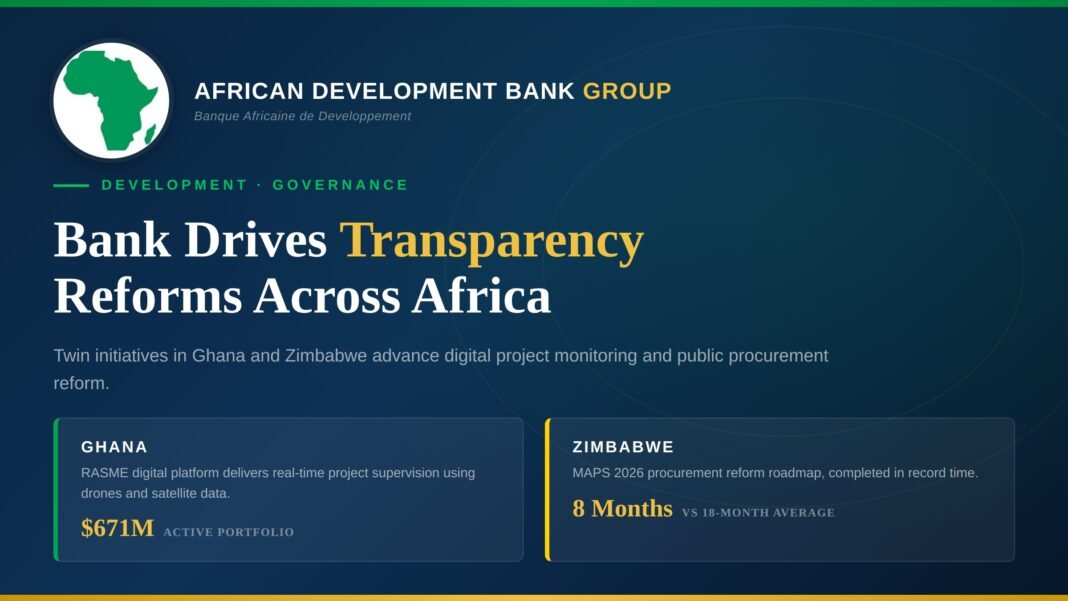
In Ghana, the Bank introduced the Remote Appraisal Supervision Monitoring and Evaluation platform, known as RASME, during a four-day capacity-building workshop held in Accra from June 16 to 19. The platform equips project teams with digital tools to collect, analyse and verify field information in real time, enabling faster evidence-based decisions throughout project implementation.
Speaking at the launch, the Bank’s Ghana Country Manager, Halima Hashi, said the platform would raise the quality of project supervision and data collection while strengthening the design and impact of future development operations across the country.
RASME allows field teams to capture georeferenced data, photographs, videos and maps using smartphones, tablets, drones and satellite imagery, giving project managers timely and verifiable information from implementation sites and reducing reliance on delayed or fragmented reporting.
The workshop drew 62 participants from Bank-financed project implementing agencies and local project management offices, who explored digital data collection and analysis tools to support more responsive implementation across sectors.
The initiative is part of the African Development Bank’s broader digital transformation agenda, which seeks to modernise project monitoring and evaluation systems and improve development results across Africa.
Ghana has been a partner of the Bank since its first operation in the country in 1973. Over five decades, the Bank has invested more than eight billion dollars in nearly 300 projects. Its current portfolio covers 21 operations with total commitments of approximately 671 million dollars, spanning agriculture, transport, energy, water and sanitation, social development and finance.
Thousands of kilometres to the south, Zimbabwe was simultaneously taking a significant stride in a different but equally important dimension of governance reform.
Vice President Constantino Chiwenga launched the Zimbabwe Methodology for Assessing Procurement Systems Report 2026 during the inaugural Southern Africa Public Procurement Forum — a document developed jointly by the Zimbabwe Government and the African Development Bank that benchmarks the country’s procurement systems against international standards and maps out a path for reform.
Chiwenga called on member states to reposition public procurement from a routine administrative function to a strategic policy instrument capable of driving infrastructure development, industrialisation, job creation and improved public service delivery.
“Procurement must be seen as a driver of economic transformation, sustainable development, and regional integration,” he said, urging deeper collaboration across the Southern African Development Community on harmonised procurement frameworks that support cross-border trade and integrated value chains under the African Continental Free Trade Area.
One aspect of the Zimbabwe report that drew particular attention was the speed of its completion. The assessment was concluded in just eight months — significantly faster than the global average of 18 months — a pace that observers said reflected the government’s seriousness about modernising its procurement systems without delay.
The report identifies priorities for strengthening governance frameworks, expanding electronic government procurement, promoting sustainable procurement practices and improving public resource management. Its recommendations are expected to inform policy reforms, build institutional capacity and deliver greater value for money in public spending.
The Bank’s Zimbabwe Country Manager, Eyerusalem Fasika, commended the Procurement Regulatory Authority of Zimbabwe and regional regulators for establishing the Southern Africa Public Procurement Forum as a platform for collaboration, innovation and institutional excellence.
She was emphatic that the MAPS report was not designed to expose failings but to build on strengths. “This is a diagnostic tool intended not to criticise procurement systems but to identify strengths and opportunities for improvement,” she said, adding that the assessment’s true value would ultimately rest on how effectively its recommendations were implemented.
Fasika reaffirmed the Bank’s commitment to supporting member countries in modernising procurement systems, describing it as central to the institution’s role as Africa’s leading development finance institution.
Taken together, the Ghana and Zimbabwe initiatives reflect a Bank that is moving deliberately to close the gap between development financing and development outcomes — one through the eyes of a drone capturing real-time site data in the field, the other through the architecture of a procurement system designed to eliminate waste, corruption and inefficiency before public funds are ever disbursed.
Both countries, in their different ways, are now positioned as reference points for the rest of the continent: Ghana for digital project supervision, Zimbabwe for procurement governance reform.