


Abuja, Wednesday, August 5, 2026
Three days after ProvidusUnity Bank was due to complete its account migration, a question is surfacing among stranded customers that goes deeper than any delayed account number: was this ever really a merger?
Every complaint routed to Unity Bank’s own staff, according to one Abuja-based business owner still without a functioning account, is redirected to Providus. Unity personnel, the customer says, appear unable to resolve anything independently — not account queries, not migration timelines, not even basic status updates.
“They just push you to Providus,” the customer said. “Unity staff sound handicapped. If this is a merger of equals, why can one side do nothing at all?”
The corporate record suggests the customer’s instinct is well-founded.
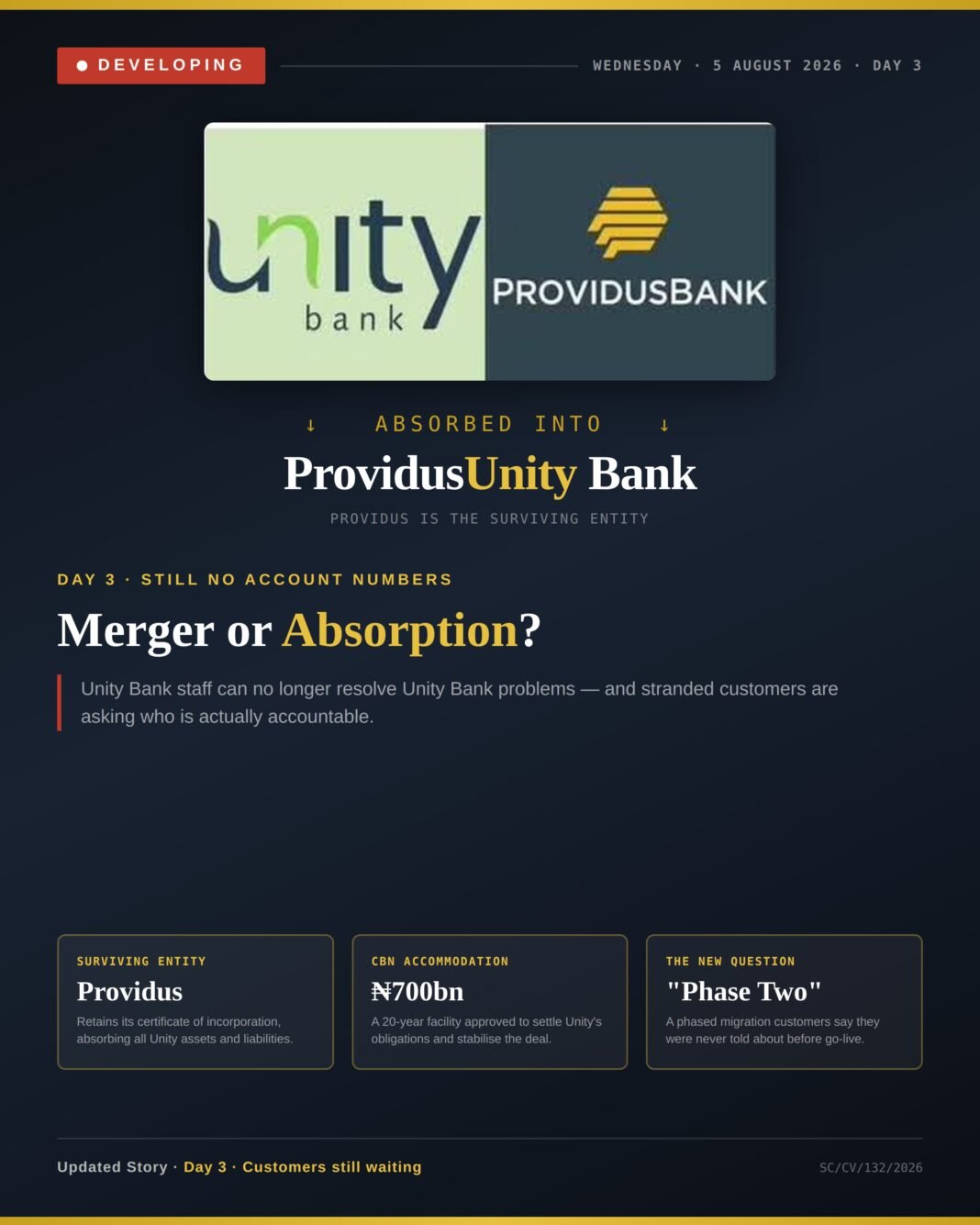
Although the transaction has been consistently described in public as a merger, its legal architecture is closer to an absorption. Under the scheme of arrangement, Providus Bank Limited is the surviving entity — it retains its own certificate of incorporation while taking on all of Unity Bank’s assets, liabilities and legal undertakings. Unity Bank, as a corporate person, effectively dissolves into it.
Before the deal was formally framed as a merger, Providus had reportedly sought for some time to acquire a majority stake in Unity outright. What tipped the balance was regulatory necessity: the Central Bank of Nigeria approved an extraordinary financial accommodation in August 2024 — a ₦700 billion, 20-year facility on concessionary terms — to settle roughly ₦303.7 billion in Unity Bank obligations and stabilise the combined institution. AMCON divested its 34 per cent stake in Unity. Shareholders approved the scheme, and the Supreme Court sanctioned it on June 1, 2026.
None of that is improper. Nigeria’s recapitalisation drive required struggling institutions to consolidate or fold, and analysts have noted the unusual reality that Unity had operated for years in a severely weakened capital position. But it does clarify a hierarchy that customers are now experiencing at the counter: one institution absorbed the other. The signage says merger. The operating reality says acquisition.
That distinction is not academic. It explains precisely why a Unity Bank staff member cannot resolve a Unity Bank customer’s problem — the systems, authority and decisions now sit elsewhere.
The phase question
A second, more troubling pattern is emerging.
The customer at the centre of this account was informed that their account falls under a later migration phase — a “phase two.” No such phased schedule appears in any public communication issued to customers before go-live. The messaging was uniform: accounts would migrate, legacy numbers would close, the transition would be seamless.
If a phased migration exists, it raises questions the bank has not addressed. How many phases are there? Which customers are in which phase? When does each phase go live? And critically — if your legacy account has been decommissioned but your phase has not yet been activated, where exactly does that leave you and your money in the interim?
A phased rollout is standard practice in core banking migrations and can be entirely sound engineering. But it only works if customers are told in advance which phase they occupy and their old account remains fully operational until their new one is confirmed live. Communicating phases only after the fact, to customers already stranded, is not a migration strategy. It is damage control.
Still waiting
For the customer in question, nothing has changed since Monday. No new account number. No written confirmation. An international payments verification with Payoneer remains frozen, awaiting a settlement account that does not yet exist.
Others have described similar paralysis, including one account holder who reported being unable to access funds while a complaint lodged with Unity Bank passed a full week without resolution.
ProvidusUnity Bank should now answer plainly: how many customer accounts remain unmigrated, what phased schedule governs them, and whether legacy account numbers stay operational until each customer’s replacement is verifiably live.
Because the deeper question customers are asking is no longer about a delayed number. It is about who is actually accountable — and whether the institution that absorbed their bank considers itself responsible for the customers that came with it.
Updated story. ProvidusUnity Bank has been contacted for comment.