

By Pai Tukum
Niger State is undergoing a transformative agricultural revolution under the leadership of Governor Mohammed Umaru Bago. Since assuming office on May 29, 2023, Governor Bago has prioritized agriculture as the linchpin of the state’s economic development and food security strategy.
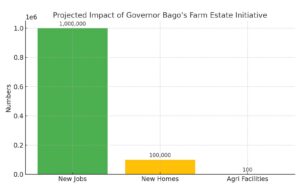
Central to Governor Bago’s vision is the establishment of modern farm estates. These estates aim to employ advanced farming techniques and technologies to boost productivity. The initiative is projected to create up to one million new jobs, provide 100,000 new homes, and develop 100 agricultural facilities across the state. This ambitious plan seeks not only to enhance food production but also to stimulate economic growth and reduce unemployment.
In collaboration with the World Food Programme (WFP), the state government is focusing on year-round farming. This approach aims to eliminate food scarcity and meet both local and international food demands. Additionally, the partnership plans to reintroduce school farms, creating job opportunities and strengthening food security.
Governor Bago’s administration treats agriculture as a business, recognizing its critical role in economic growth and food availability. This policy framework is designed to strengthen national capacities for food production, supply, and resilience to food crises and disasters.
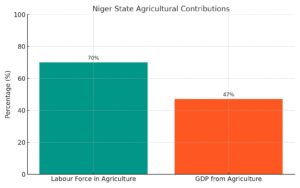
Agriculture contributes significantly to Niger State’s economy, employing about 70% of the labor force and accounting for approximately 47% of the state’s GDP. The sector encompasses farming, fishing, and cattle rearing, with major crops including millet, sorghum, cassava, rice, and various vegetables.
Despite advancements, challenges such as climate change, desertification, and population growth persist. To address these, the state is investing in sustainable practices and infrastructure to bolster resilience against environmental and economic pressures.
Governor Bago’s agricultural revolution is positioning Niger State as a leader in food security and economic diversification. By leveraging the state’s agricultural potential, the administration aims to create a self-sustaining economy that not only feeds its population but also contributes to national and global food supplies.