

Africa has entered a new and more demanding phase of its digital transformation journey, one where commitments made at global summits must now translate into measurable improvements in the lives of ordinary citizens across the continent.
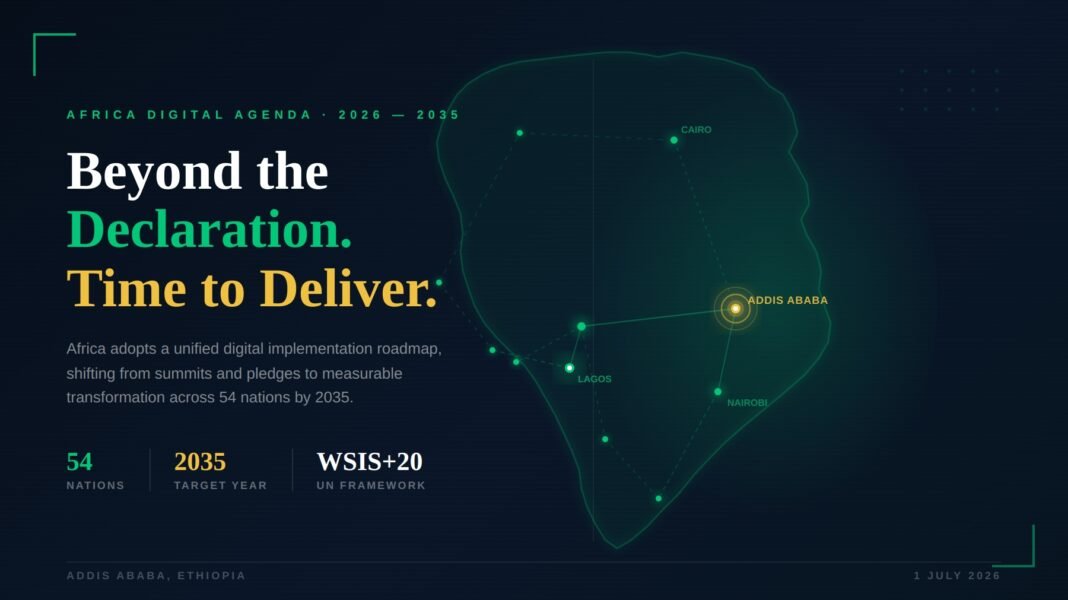
That was the central message as the United Nations Economic Commission for Africa (ECA) unveiled the Africa 2035 Digital Implementation Roadmap at a two-day regional consultation that opened in Addis Ababa, Ethiopia, on Tuesday.
The consultation, convened under the theme of operationalising outcomes from the World Summit on the Information Society’s 20-year review, brought together government representatives, parliamentarians, technology stakeholders and development partners to align on how the continent intends to deliver on its digital agenda between now and 2035.
ECA developed the roadmap in collaboration with the Government of Ethiopia to serve as a unified continental framework, pulling together existing instruments — including the African Union’s Agenda 2063, the AU Digital Transformation Strategy, continental data governance frameworks, and artificial intelligence policy initiatives — into a single, coherent delivery architecture rather than a collection of parallel and often competing programmes.
Speaking at the opening session, Hon. Alidjanatou Saliou Arekpa, representing the Republic of Benin and the Network of African Parliamentarians for Digital Governance, was direct about the purpose of the gathering.
“We have not come to Addis Ababa to rewrite Cotonou. We have come to take stock and accelerate progress,” she said, calling for faster delivery of commitments under the 2025 Cotonou Declaration and stronger parliamentary engagement in shaping digital governance across the region.
Addressing the meeting virtually, Ms. Isabelle Lois, Vice-Chair of the UN Commission on Science and Technology for Development, praised ECA for its leadership role in developing the roadmap, describing the work as critical to building inclusive, multi-stakeholder digital partnerships across Africa.
Mr. Samuel Kobina Annim, Director of the African Centre for Statistics at ECA, acknowledged that while digital infrastructure had expanded significantly across the continent, serious gaps in access, usage and inclusion persisted. He said the roadmap was designed to directly confront those gaps.
“Digital transformation is central to achieving the Sustainable Development Goals and Agenda 2063,” Annim said, adding that the framework would help reduce fragmentation, establish standardised reporting indicators, and bring coherence to how Africa tracks and communicates its digital progress at continental scale.
Representing the host government, Mr. Seyoum Mengesha of Ethiopia’s Ministry of Innovation and Technology noted that digital transformation had become a core pillar of national development strategy across the continent, not merely a technology initiative.
“It is fundamental to inclusive growth, better public services, competitiveness, youth opportunities and regional integration,” he said, pointing to Ethiopia’s own investments in digital public infrastructure, digital identity systems, e-government services, broadband expansion and cybersecurity as evidence of that commitment.
The consultation is expected to produce agreed priorities on how member states will implement and report on their digital commitments under both the WSIS+20 resolution and the Global Digital Compact, with a proposed joint framework for monitoring progress on digital inclusion, infrastructure, governance and meaningful connectivity.
Speakers across sessions were consistent on one point: Africa’s digital ambition has matured beyond the question of connectivity alone. The continent now demands that digital transformation deliver tangible outcomes — jobs created, health services improved, education access expanded, governance strengthened, and innovation ecosystems built that work for Africans.
Progress, they agreed, will no longer be measured by the number of declarations signed, but by evidence of change on the ground.