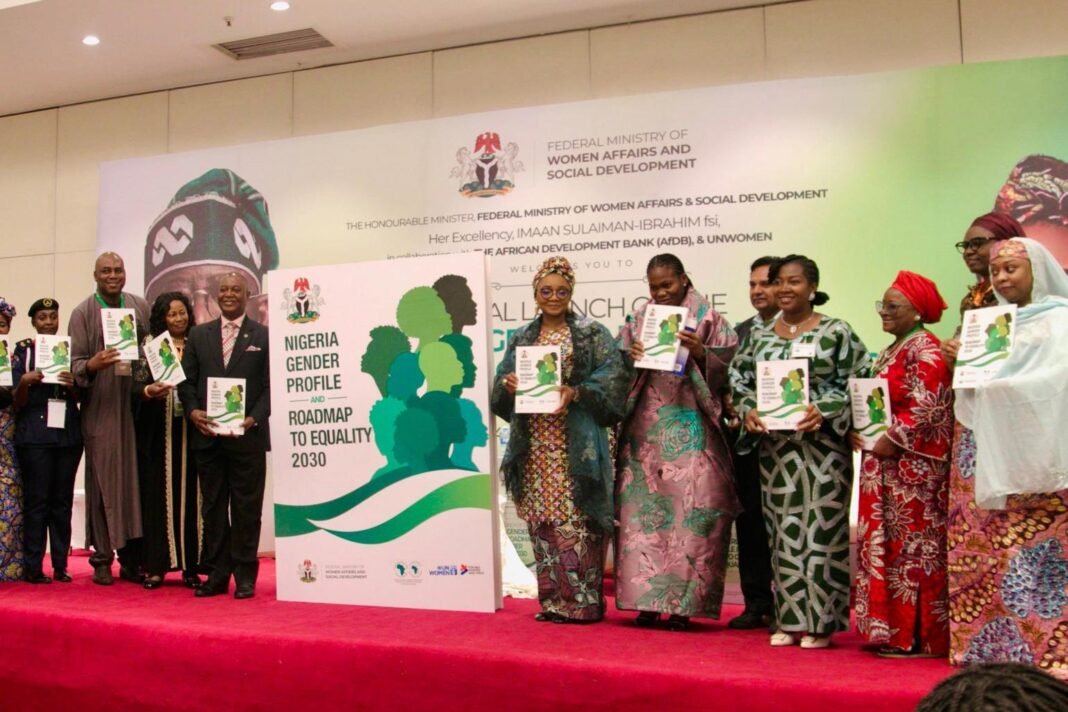

The African Development Bank, the Federal Ministry of Women Affairs and Social Development, and UN Women Nigeria jointly launched the Nigeria Gender Profile and Roadmap to Equality 2030 in Abuja, a framework designed to turn years of diagnosis into concrete action. The launch, held on 24 June, drew together government, development partners, the private sector and civil society around a single goal: coordinated movement on women’s empowerment rather than scattered, stop-start effort.
What sets this framework apart is its refusal to stop at analysis. Gender assessments are nothing new in Nigeria shelves of them exist. This one pairs the evidence with an action-oriented roadmap spanning eight priority areas, moving deliberately from diagnosis to delivery. The Profile lays out the structural gaps across the economy, education, health, leadership, governance and protection from gender-based violence; the roadmap converts those findings into solutions institutions can actually implement.
The report is part of the Bank’s wider Country Gender Profiles programme, running across the continent, which builds tailored evidence on where women are being left behind sector by sector. Crucially, the Nigeria edition treats gender equality not as a side issue but as a whole-of-economy priority one requiring joined-up action from education and finance through to infrastructure and governance, backed by sustained investment and firm accountability.
That framing was echoed by the officials who launched it. Imaan Sulaiman-Ibrahim, Nigeria’s Minister of Women Affairs and Social Development, cast equality in hard economic terms rather than as charity. Equality, she argued, is not a concession but a sound investment in national strength when women and girls gain equal access to education, finance, leadership and security, families grow more stable, communities more resilient, and the economy expands.
For the African Development Bank, the launch marks a shift in how it treats the issue in Nigeria. Dr Abdul B. Kamara, the Bank’s Acting Vice President for Regional Development, Integration and Business Delivery and its Director General for Nigeria, noted that the country is among the first where gender has been raised from a cross-cutting theme to a strategic pillar of the Bank’s own country strategy. His argument was pointed: gender equality does not compete with economic growth it is a precondition for it.
Beatrice Eyong, UN Women Representative to Nigeria and ECOWAS, situated the agenda even more broadly, describing equality as the thread running through economic transformation, democratic governance, human capital, climate resilience and lasting peace. Where equality advances, she said, development accelerates.
The roadmap is deliberately wired into existing plans rather than left to float on its own. It aligns with Nigeria’s National Development Plan 2026–2030, embedding gender priorities directly into policy and investment decisions, and dovetails with the Bank’s Gender Strategy and its Nigeria Country Strategy Paper for 2025–2030. It also advances Nigeria’s long-standing commitments under the Beijing Platform for Action and arriving in the Beijing+30 year, it lands as a renewed push for implementation and results that can be counted, not merely promised.
The framework was shaped by nationwide consultations and input from Nigerian experts, a process intended to give it both technical weight and genuine national ownership. That matters, because the true test of any roadmap is not its launch but its follow-through. The evidence and the plan now exist. Whether Nigeria’s institutions convert them into schools attended, loans accessed, offices held and women protected is the measure that will decide if 2030 becomes a milestone or another missed date.