

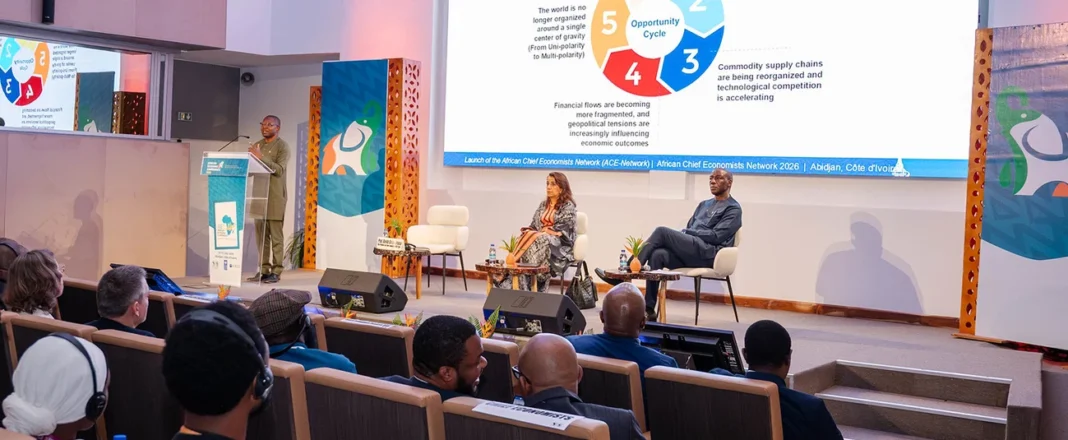

The 2026 African Economic Conference (AEC) concluded on Sunday with renewed calls for stronger African policy coordination, greater trade resilience and the launch of a continental network of chief economists to strengthen evidence-based economic policymaking across the continent.
The three-day conference, jointly organised by the African Development Bank Group, the United Nations Development Programme and the Organisation for Economic Co-operation and Development, brought together economists, policymakers, central bank officials, researchers, academics and development practitioners under the theme: “Strengthening Africa’s Geopolitical Agency and Trade Resilience in a Multipolar World.”
One of the conference’s major outcomes was the launch of the African Chief Economists Network (ACE-Network), a continent-wide platform designed to improve collaboration among Africa’s leading economists and strengthen the use of evidence in shaping economic policies.
The network is expected to bring together chief economists from development finance institutions, multilateral organisations, governments, central banks, academia, think tanks and the private sector to exchange research, coordinate policy responses and develop African-led solutions to emerging economic challenges.
Speaking at the closing ceremony, Senior Vice-President of the African Development Bank Group, Marie-Laure Akin-Olugbade, who represented the Bank’s President, Dr Sidi Ould Tah, described the conference as a platform that generated practical ideas for strengthening Africa’s economic resilience in an increasingly uncertain global environment.
She urged policymakers and development partners to translate the conference’s recommendations into concrete actions capable of improving livelihoods across the continent.
Participants examined strategies for enhancing Africa’s position in global trade, strengthening regional value chains, improving development finance, accelerating industrialisation and increasing investment in research, innovation and digital transformation.
The conference also explored emerging issues such as climate resilience, artificial intelligence, public investment efficiency, institutional reforms and the implementation of the African Continental Free Trade Area (AfCFTA).
The African Development Bank’s Chief Economist and Vice-President for Economic Governance and Knowledge Management, Prof. Kevin Urama, said Africa must strengthen its research capacity and knowledge systems to enable governments to respond effectively to rapidly evolving global economic challenges.
He stressed that improved investment in data, research institutions and policy coordination would complement ongoing investments in physical infrastructure and position Africa to play a stronger role in global economic governance.
The ACE-Network is expected to operate as a collaborative platform, holding annual meetings alongside the African Economic Conference, quarterly virtual engagements and special sessions during periods of major regional or global economic shocks.
Development partners at the conference also emphasised the need for integrated policy approaches as trade, investment, debt sustainability, climate finance and fiscal policy become increasingly interconnected.
They noted that stronger cooperation among African institutions would help reduce duplication, improve decision-making and strengthen the continent’s contribution to global policy discussions.
The conference further hosted the annual meeting of the Global Network of Chief Economists of Development and Financing Institutions, reinforcing efforts to deepen collaboration among Africa’s economic policy leaders.
Participants agreed that although Africa possesses significant comparative advantages—including a youthful population, abundant natural resources, expanding digital markets and the world’s largest free trade area under the AfCFTA—greater policy coordination, stronger institutions and sustained investment in knowledge and innovation would be essential to transform those assets into long-term, inclusive growth.
They also stressed that Africa’s future competitiveness would depend on its ability to strengthen domestic industries, mobilise investment, deepen regional integration and build resilience against global economic shocks.
The conference ended with a commitment by the African Development Bank, UNDP and OECD to continue working with African governments and development partners to promote evidence-based policymaking and accelerate the continent’s economic transformation.




 concluded on Sunday with renewed calls for stronger African policy coordination, greater trade resilience and the launch of a continental network of chief economists to strengthen evidence-based economic policymaking across the continent.)